
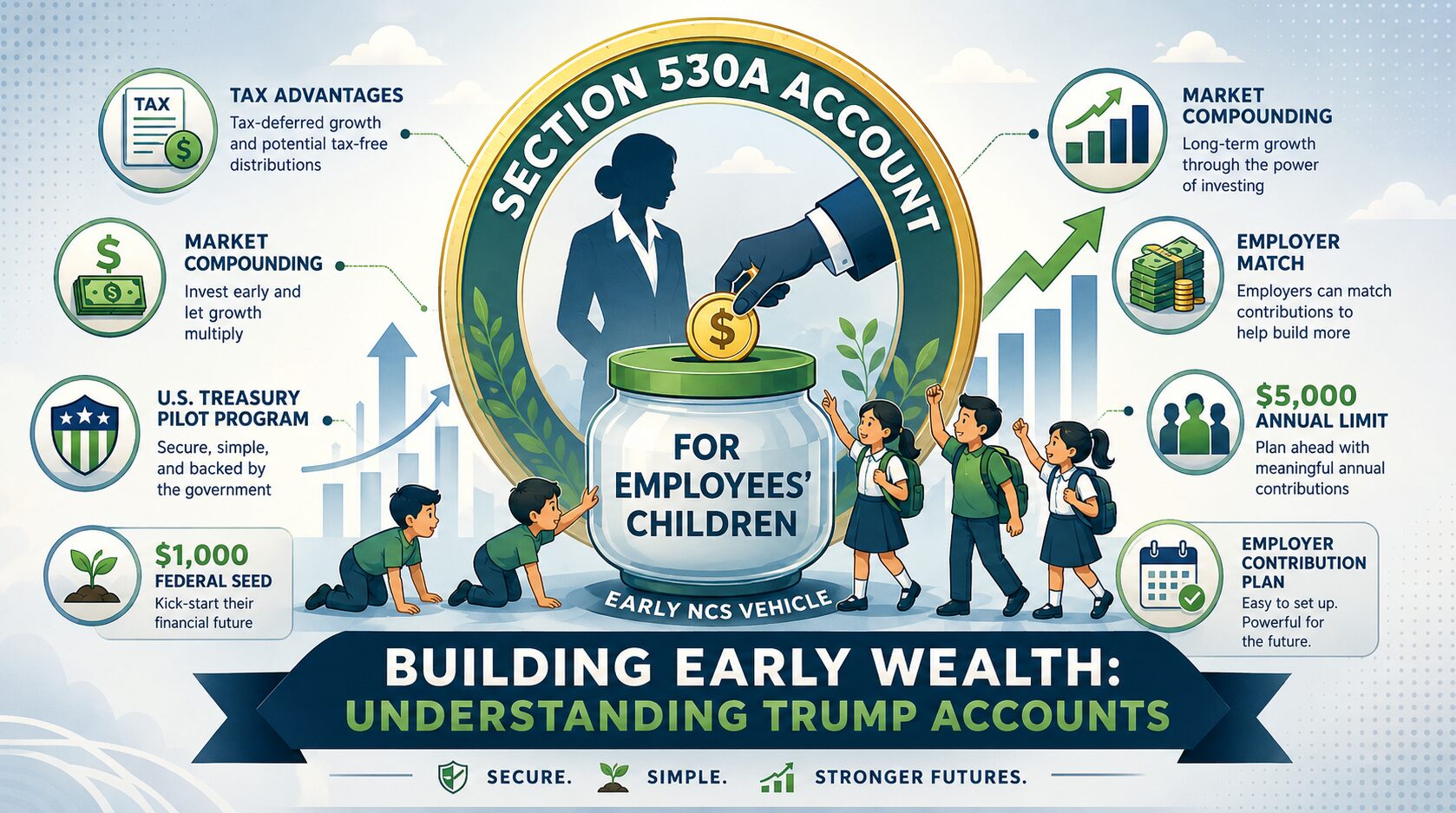
Beginning July 4, 2026, families will be able to contribute to newly created Trump Accounts, a tax-advantaged investment account for children established under Internal Revenue Code Section 530A. The program also includes a one-time $1,000 Treasury pilot contribution for certain eligible children born between 2025 and 2028.
Trump Accounts are designed for long-term investing. They place meaningful limits on investments and withdrawals while a child is under 18, with most traditional IRA rules beginning to apply once the child reaches adulthood.
What Is a Trump Account?
A Trump Account is a type of traditional IRA established for the exclusive benefit of a child. The child is the account owner, while the adult who completes the account election generally serves as the responsible party while the child is still a minor.
During the account’s “growth period,” special rules apply. The responsible party can select from the permitted investments, oversee account activity, and request certain approved transfers. However, the account is subject to stricter investment and withdrawal rules than a typical IRA.
The growth period begins when the account is established and ends on December 31 of the year before the calendar year in which the child turns 18. Beginning January 1 of the year the child turns 18, most traditional IRA rules generally apply.
Importantly, the account does not automatically convert into a separate traditional IRA at age 18. It may continue as a Trump Account, although a trustee may offer an automatic transfer to a traditional IRA after the growth period ends.
Who Can Open a Trump Account?
To establish an initial Trump Account, the child generally must:
- Be under age 18 at the end of the calendar year in which the election is made.
- Have a valid Social Security number issued before the election is made.
- Not already have an initial Trump Account election filed on their behalf.
There is no earned-income requirement for the child, unlike with a standard Roth IRA. The contribution rules also do not impose a parental income limit.
A parent, legal guardian, adult sibling, or grandparent may be authorized to establish an account, depending on the family’s circumstances and whether another authorized person has already made the election.
The $1,000 Treasury Pilot Contribution
A one-time $1,000 pilot contribution is available for eligible children who meet all of the following requirements:
- They were born between January 1, 2025, and December 31, 2028.
- They are U.S. citizens.
- They have a valid Social Security number.
- An eligible individual files the required election for the child.
- No prior pilot-program election has been processed for that child.
The $1,000 is not automatic. An authorized individual must establish the Trump Account and elect the pilot contribution through Form 4547 or the approved online process. Treasury has stated that no pilot-program deposit will be made before July 4, 2026.
Children born before 2025 are not eligible for the $1,000 pilot contribution. However, they may still be eligible to have a Trump Account established if they meet the general account requirements.
Contribution Limits
During the growth period, parents, grandparents, relatives, friends, employers, and others may contribute to a child’s Trump Account.
For 2026 and 2027, the combined annual limit for ordinary contributions is $5,000 per child. This includes contributions from individuals and qualifying employer contributions. The limit is scheduled to receive cost-of-living adjustments beginning after 2027.
The following generally do not count toward the $5,000 annual limit:
- The $1,000 Treasury pilot contribution.
- Qualified general contributions made through certain government or charitable programs.
- Qualified trustee-to-trustee rollovers from another Trump Account.
Individual contributions are not deductible. In other words, parents and other contributors generally use after-tax dollars when making their own contributions.
Employer Contributions: A Potential Workplace Benefit
Employers may offer contributions to a Trump Account through a qualifying Section 128 Trump Account contribution program.
Under the current rules, an employer may contribute up to $2,500 per employee per year, subject to future inflation adjustments after 2027. The contribution may be made to the employee’s own Trump Account or to the Trump Account of the employee’s dependent.
When the contribution is made through a qualifying employer program, it is generally excluded from the employee’s gross income. However, the $2,500 employer limit is part of the child’s overall $5,000 annual contribution limit for ordinary contributions.
This is an important distinction: an employer contribution is not automatically tax-free simply because an employer sends money to a child’s account. The employer must offer the benefit through a qualifying program that meets the applicable rules.
Employees should ask their human-resources or benefits department whether their workplace offers a Trump Account contribution program, what children qualify, and whether the company provides a match, a fixed contribution, or another benefit structure.
Investment Rules: What Can the Money Be Invested In?
Trump Accounts are intentionally limited to certain long-term, diversified investments while the child is under 18.
During the growth period, account assets may generally be invested only in eligible mutual funds or exchange-traded funds that:
- Track the S&P 500 or another qualifying index made up primarily of U.S. companies.
- Do not use leverage.
- Charge annual fees and expenses of no more than 0.10%.
- Meet any additional Treasury requirements.
That means individual stocks, options, cryptocurrency, sector-specific funds, and other nonqualifying investments are not permitted during the growth period.
Withdrawal Rules Before Age 18
Trump Accounts are built for long-term investing, so distributions are generally restricted before the year the child turns 18.
During the growth period, distributions are generally allowed only for:
- A trustee-to-trustee rollover into another Trump Account.
- A qualified rollover into an ABLE account during the calendar year the beneficiary turns 17.
- Removal of excess contributions.
- Distributions following the death of the account beneficiary.
Beginning January 1 of the calendar year in which the child turns 18, most regular traditional IRA distribution rules begin to apply. Early distributions may be subject to ordinary income tax and, in some cases, the 10% additional tax on early distributions unless an IRA exception applies.
How Taxes Work
Trump Accounts are tax-advantaged, but they are not the same as Roth IRAs.
Individual contributions made by parents, relatives, or other private contributors generally create basis in the account because those contributions are made with after-tax dollars. That basis is generally not taxed again when distributed later.
However, the Treasury pilot contribution, qualifying employer contributions, qualifying general contributions, and investment earnings generally do not create basis. After the growth period, amounts distributed from those sources are generally taxable under traditional IRA rules.
The Power of Compounding
A $1,000 Treasury pilot contribution left invested for 18 years could grow substantially, depending on market performance.
| Hypothetical Annual Return | Approximate Value After 18 Years |
|---|---|
| 6% | $2,854 |
| 8% | $3,996 |
| 10% | $5,560 |
For a larger illustration, assume a family receives the $1,000 pilot contribution at the start and contributes the full $5,000 annual limit at the end of each year for 18 years. At a hypothetical 10% annual return, the account could grow to approximately $284,000.
These are mathematical illustrations only. They do not account for inflation, investment costs, taxes on future distributions, changes to contribution limits, or market losses. Investment returns are never guaranteed, and all investing involves risk, including possible loss of principal.
How to Open a Trump Account
The account-opening process is handled through the IRS and Treasury’s official Trump Accounts systems.
- Create or sign in to an IRS Individual Account.
The IRS uses ID.me for account access and identity verification. - Complete Form 4547, Trump Account Election(s).
This form is used to establish an initial Trump Account and, when applicable, elect the $1,000 Treasury pilot contribution. - Monitor the election status.
The IRS Individual Account allows taxpayers to view the status of submitted Trump Account elections. - Complete the activation process.
Once the election is processed, Treasury or its agent provides activation instructions for the account. - Begin contributions on or after July 4, 2026.
Contributions cannot be accepted before July 4, 2026. Treasury has also stated that eligible $1,000 pilot contributions will begin being deposited on or after that date.
Account Security and Scam Awareness
During the initial rollout, Treasury stated that activation emails would come from no-reply@TrumpAccounts.Treasury.gov. Families should use the official Trump Accounts app, the official Treasury portal, or their IRS Individual Account to verify account activity.
Do not rely on phone numbers found through search results or unsolicited messages. Treasury directs users to use secure in-app or online callback requests for customer support.
Bottom Line
Trump Accounts create a new long-term savings option for children. The program allows eligible families to establish an IRA-style account for a child without requiring the child to have earned income, and certain children born between 2025 and 2028 may qualify for a $1,000 Treasury pilot contribution.
For families with access to an employer contribution program, the account may provide an additional workplace benefit. Still, the rules are detailed: contributions are capped, investment choices are restricted, withdrawals are generally unavailable before adulthood, and future distributions are governed largely by traditional IRA tax rules.
Before opening or funding an account, review the current IRS instructions and consider speaking with a qualified tax professional or financial adviser about how a Trump Account fits with other options such as a 529 plan, Roth IRA, or custodial investment account.
Official Resources
For current forms, eligibility details, activation instructions, and updates, use:
- Official Account Portal: TrumpAccounts.gov
- IRS Tax Law and Notice Hub: IRS.gov/TrumpAccounts
- U.S. Department of the Treasury: Treasury.gov